Interview - Christian Maudet - AFNOR SPEC 2212
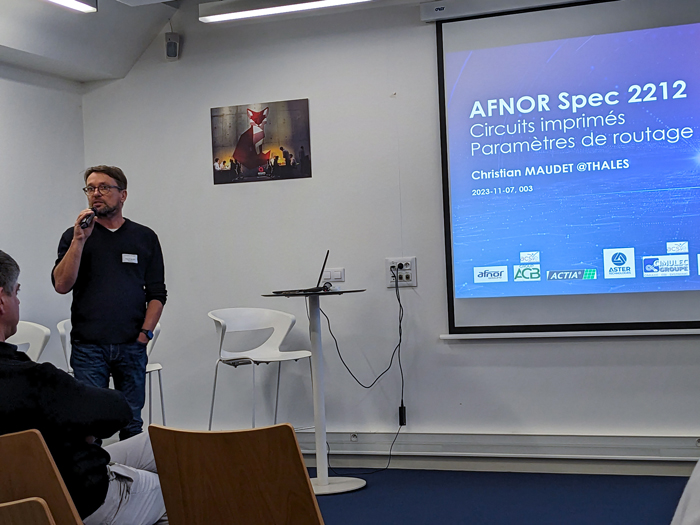
Hello Christian, could you introduce yourself in a few words?
Hello Grégoire. Let me take this opportunity to say once again that I remain as impressed as ever by your commitment to the placement and routing of electronic boards. For my part, I have 35 years of experience within the Thales Group, 
Can you explain why you chose to create the AFNOR SPEC 2212 rather than update the NF C93-713 standard?
The NF C93-713 standard covered, in an extremely effective way, both design rules and acceptance criteria, including tooling, all in just a few pages. The last edition dates from 1989 and, as a side note, it was automatically made obsolete 30 years later, in 2019, amid general indifference, because no standardization committee on electronics was still active in France. That does not stop us from coming across a great many routing design guides, built on the approach proposed by NF C93-713 with parameters updated to a greater or lesser extent, whether in France, in Europe or around the world. We ourselves came across an expanded version of NF C93-713 written in Mandarin.
In 1993, on my first visit to the Brasage soldering congress at CNET(3) in Lannion, a temple of electronics, I dared, despite being young in the field, to challenge my peers on the need to update NF C93-713. The answer I received was that it would indeed be good to do so… Everyone relied on this document for design, and everyone achieved sound industrial work by construction. The word DFM(4) did not exist, because it was naturally embodied in the best practices known to all. Over the years, I regularly urged the industry to get started, but found no echo in the new industrial ecosystem that had emerged from the spin-off strategies applied to manufacturing activities in many large groups. The 2000s saw the arrival of the IPC(5) standards, which took the place left vacant by the abandonment of the NF approach, and I was told that IPC would meet my expectations. On the contrary, I observed a growing dispersion of routing practices and rules coming from all directions, which pointed to the inadequacy of that answer. In 2009, I initiated a “Thales Routing Classes” program with all our industrial partners, and we quickly demonstrated that an effective parametric framework could be established for routing electronic boards. This document quickly became one of the flagship items of our internal Technical Reference system, inspiring genuine attachment. It was then only natural to propose making this work permanent by initiating a standardization process. The AFNOR SPEC 2212 venture is the answer to that ambition.
How did you select the partners involved in this project?
In 2016, I organized a seminar in Cholet entitled “Electronic Design For Industry”, preceded the evening before by a conference devoted to “standardization: a competitiveness challenge”. I had brought in Louis Gallois' think tank “La Fabrique de l'Industrie”, AFNOR(6) and IFTEC(7), among others. As an aside, I remember hearing, on my arrival for my first visit to AFNOR in early 1996: “why do you want to launch an initiative in this field? There is no electronics industry left in France…”. I held on.
Surprisingly, in 2019-2020, I was asked to lead a working group, as part of the IPC Design Council France of which I was a member, to map routing practices in France, in Europe and worldwide. The dispersion of practices, good and bad, went far beyond what was being said, which confirmed what I had been observing for many years. At the end of that effort, we recommended initiating a standardization process. IPC considered that it addressed this properly, which was not what we observed. An IEC(8) approach, through AFNOR, stood out as the most legitimate route for establishing a normative framework. The core group that had chosen to join that survey, ID3-MBDA-Safran-Seb-Thales, carried over into the AFNOR SPEC 2212 project, joined by two PCB manufacturers put forward by ACSIEL(9): Atlantec (ACB Group) and CSI (Groupe Cimulec), an EMS(10), Actia, represented by its design office, and the software vendor ASTER Technologies. A team that could not lose.
Can you describe how you organized the working group that developed the AFNOR SPEC 2212?
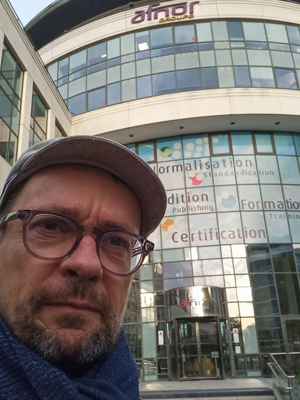
The agreement with AFNOR was: 5 plenary meetings, and a result in both French and English, freely available. We were remarkably efficient thanks to the diversity of the companies and sectors represented. I had gained substantial experience in leading networks, and I had learned to stay focused on the end users' needs and on how they would access the result. All the group members had, to varying degrees, initiated approaches similar to those of Thales, and they had converged on certain common rules, but with different values. This made it easy to frame the objective and identify the foundation to address. Beyond the plenary meetings held at AFNOR's offices, we devoted a great deal of time to preparing each milestone to ease the trade-off decisions, while also remaining strongly committed to a concise and visually appealing result, so as to foster future attachment. The result is not a watered-down compromise; I was very vigilant that we achieve a high-quality result, structuring for today and for tomorrow.
How were the sections, parameters and values chosen?
The sections selected are the ones well known to the profession. They were easy to identify, and we bounded the scope of the work to be sure of reaching the objective. We identified the rules to address for each section based on the end need: what is required to parameterize a technical environment. To define the values associated with these rules, we shared our operational experience and proposed trade-offs under the oversight of the PCB manufacturers. Some parameters required several hours of “lively” but well-argued work, and we always converged without falling back on that infamous watered-down compromise. We brought genuine, structuring innovations, such as the ability to identify, very early on, the “Routing Class” consistent with the choice of component packages, but also the way the complexity of copper thicknesses is handled as a function of via technologies, for example.
How can you guarantee that the AFNOR SPEC 2212 values are compatible with all printed circuit board manufacturers?
Yes, absolutely. Atlantec and CSI, the 2 representatives put forward by ACSIEL's Printed Circuit Board College, had the mission and the obligation to represent all the affiliated printed circuit board players. It should also be noted that several other manufacturers and OEMs were consulted during the final review phase of the document, including foreign partners. This “non-adherence”, by construction, to a narrow industrial base was deliberately sought.
Are there plans to update the AFNOR SPEC 2212 values in the future?
To date, after several months of use, we have collected very few requests to modify this first edition. This well-thought-out foundation can now be put forward for promotion to IEC, building on the English version available today. This new stage will be an opportunity for new trade-offs and possible additions. To support the international promotion, we also reactivated the UF-91(11) standardization committee in early 2022, with the ambition of turning the AFNOR SPEC 2212 into an IEC standard, a committee that had been dormant for far too long in France, a situation that had prevented an effective legacy from being maintained. The DGA(12) quickly understood the benefits of this approach and agreed to chair the committee, a genuine recognition of this work. Going through an AFNOR SPEC-type document ultimately proved very effective, because it allowed us to move quickly and to demonstrate feasibility collectively. I like to say that it is the antechamber to standardization.
Is it possible to add new parameters to the AFNOR SPEC 2212?
We are indeed being asked to broaden the scope covered: rigid-flex and flex circuits, but also component assembly and testing, with an equivalent approach. The decisions have yet to be made. I am in favor.
Is the AFNOR SPEC 2212 also compatible with assembly houses, particularly regarding solder mask rules?
Yes, absolutely. We tested the choices made with EMS companies. We bring clarity to the definition of the solder mask, an element that must be taken into account in design with the same rigor as copper. To back this up, I can reveal that we are working with the vendor Cadence to finally revolutionize the way the solder mask is defined in design, and to abandon the “negative” handling inherited from the manual “photo-negative” work of the 1970s-1990s.
Finally, can you explain the difference between the AFNOR SPEC 2212 and the IPC standard?
IPC has established itself as the framework for acceptance criteria in manufacturing. However, this standard has not met expectations on the design side. The divergent practices observed are no longer sustainable for overall competitiveness. The AFNOR SPEC 2212 addresses these competitiveness challenges. The interest shown in this work by CAD and CAM(13) software vendors is the best proof of that. They were waiting for this parametric framework to feed their DRC(14) engines and their simulation parameters. The icing on the cake: applying the AFNOR SPEC 2212 parameters in design will guarantee, by construction, that the IPC Class 2 and Class 3 acceptance criteria are met in manufacturing.

Christian MAUDET

Grégoire BOULAY
FRANCE CAO encourages you to download and read the latest version of AFNOR SPEC 2212 on the official AFNOR website, to ensure a complete and accurate understanding of the document. FRANCE CAO declines any liability regarding the accuracy or completeness of the information provided, and strongly recommends consulting the official source directly for any specific use or interpretation.
FRANCE CAO has obtained the reproduction, publication and exploitation rights for AFNOR SPEC 2212, allowing it to use this data in accordance with the terms of the intellectual property rights concession agreement established with AFNOR.
© AFNOR Editions - AFNOR SPEC 2212, 2023. Tous droits réservés.
PCB design rules: which values should you choose?
What is AFNOR SPEC 2212?
How to choose your routing class in AFNOR SPEC 2212
Advanced use of the AFNOR SPEC 2212 dynamic routing class ta…
Interview - Christian Maudet - AFNOR SPEC 2212
Interview - Noémie Thoores - AFNOR SPEC 2212
AFNOR SPEC 2212 goes international: IEC PAS 63720