What is AFNOR SPEC 2212?
Video hosted by YouTube: playing it here means accepting YouTube's cookies.
In two sentences:
AFNOR SPEC 2212 is a reference document that defines the routing parameters of printed circuit boards. It is a practical guide that aims to optimize the design and manufacturing of electronic boards, taking into account quality, cost and performance requirements.
How does it work?
Classify your PCB:
AFNOR SPEC 2212 lets you classify your board using routing classes, also referred to as Routing Classes (RC).
This classification takes its inspiration from the NF C93-713 standard, which dates back to 1989 and became obsolete as electronic technologies evolved.
Routing classes are mainly determined by the components present on your PCB. You will find a chapter in this course on how to choose your Routing Class.
More than 800 values:
Once you have selected your Routing Class among the 10 available, you get access to more than 60 constraint parameters, ready to be used in your PCB routing tools.
Note that some software vendors have already planned to provide these constraints directly in their CAD tools.
For some parameters, you can choose between a preferred value, a range of values [] or a limit value that should not be exceeded (). The mention NA, or the absence of a value, indicates a configuration that is not recommended.
What are the benefits of AFNOR SPEC 2212?
Electronics hardware engineers:
- Anticipate the cost and technology of your board by choosing your routing class wisely.
- Minimize the risk of manufacturing defects by aligning your constraints with the routing classes. Easily identify constraints that are tighter than necessary.
- Broaden your sourcing options by designing a board that every manufacturer can build.
- Make it easier to compare manufacturers on cost and capabilities thanks to this common reference.
PCB designers:
- No more mistakes or open questions about which limits and values to apply.
- Use the right values from the start of the project to save time, achieve a better design and reduce last-minute rework.
PCB manufacturers:
- Reduce board scrap thanks to fewer needlessly complex designs. For example, when the hole-to-track constraint needlessly pushes the routing class higher because of a designer's bad habit rather than an actual lack of space.
- Reduce back-and-forth with designers by speaking the same language.
The board itself:
- Better density, with the best constraint values entered.
- Better reliability, with harmonized constraints.
- Better lead time, with fewer exchanges and fewer surprises.
- Better placement/routing, thanks to the last-minute rework avoided.
Who wrote AFNOR SPEC 2212?
AFNOR SPEC 2212 was developed by a group of French experts in design, processes and manufacturing, made up of the 12 people presented below:
| Participants | Role, Organization |
|---|---|
| BAUDET Damien | THALES GLOBAL SERVICES SAS |
| CHAILLOT Agnès | MBDA FRANCE |
| CHETANNEAU Patrice | SAFRAN ELECTRONICS & DEFENSE |
| CISSÉ Alioune | AFNOR |
| LARIONOFF Emmanuel | CIMULEC GROUPE/ACSIEL Alliance Électronique |
| LELOU Nicolas | GROUP ACB/ACSIEL Alliance Électronique |
| LOTZ Christophe | ASTER TECHNOLOGIES |
| MAUDET Christian | THALES SIX SAS |
| MANTEIGAS David | MBDA FRANCE |
| MARAIS William | ID3 TECHNOLOGIES |
| NOËL Sébastien | GROUPE SEB |
| NOUVEL Gérard | ACTIA AUTOMOTIVE |
The initiative came from Christian Maudet, who had already created Routing Classes for internal use within the THALES group as early as 2009. He had also involved many circuit board manufacturers at the time.

Where can you find AFNOR SPEC 2212? And at what price?
The expert group chose to publish AFNOR SPEC 2212 through AFNOR (Association Française de Normalisation).
AFNOR SPEC 2212 is a voluntary application document, which means it can be downloaded free of charge from the AFNOR website. It comes as a PDF with tables, illustrations and definitions, along with other information.
I invite you to download it here.
You will also find a printable condensed version here, in A3 format, which can be used as a desk pad. This version displays all the tables of AFNOR SPEC 2212.
You can find here the dynamic Routing Classes table to make your searches easier. I strongly encourage you to try it! It will save you time and make your search more reliable.
A few precautions all the same!
As AFNOR reminds us in the “Foreword” of the AFNOR SPEC, the use of this document does not entail any liability for AFNOR or its authors. First of all, I invite you to download and read the document available on the AFNOR website.
Do not hesitate to contact your circuit board manufacturer and provide them with this document if they are not aware of it. They will then be able to validate the feasibility of your board. Your PCB manufacturer will most likely tell you that some rules can be advantageously reduced at identical cost and/or equal quality. In that case, make sure to check compatibility with your sourcing policy for PCB manufacturers, as other manufacturers may not have the same manufacturing capabilities.
Conclusion:
AFNOR SPEC 2212 is a powerful tool for engineers, PCB designers and manufacturers. It modernizes and optimizes the design and manufacturing process. Explore its benefits, use its values and improve your electronic projects with this well-thought-out AFNOR SPEC.
Are you asking yourself these questions too?
What is the difference between AFNOR SPEC 2212 and the IPC standard?
Why wasn't the NF C93-713 standard simply updated?
What are the next steps?
I had the opportunity to ask these questions, among many others, to Christian Maudet, the initiator of AFNOR SPEC 2212, and to Noémie Thoores from the AFNOR Group. I invite you to discover their answers in the next chapters.
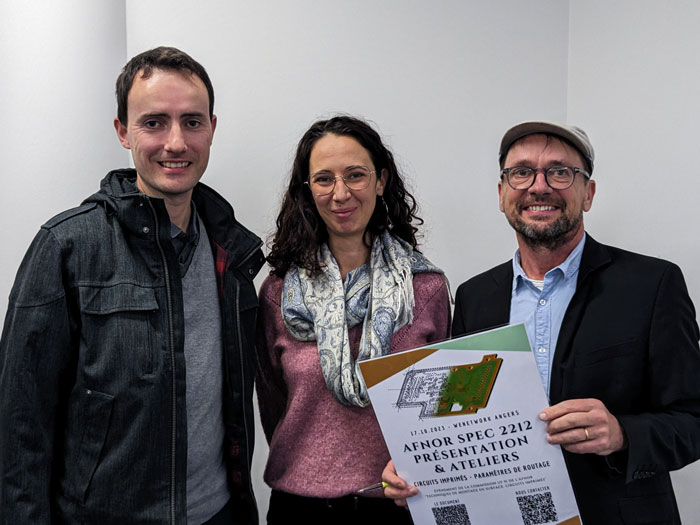
Did you know?
When we say AFNOR SPEC 2212, the words “AFNOR SPEC” refer to a type of document. So it is not strictly “correct” to call it “Spec 2212” or the “2212 specification”. Clever naming, isn't it? Noémie Thoores tells us more about this in her interview.
FRANCE CAO encourages you to download and read the latest version of AFNOR SPEC 2212 on the official AFNOR website, to ensure a complete and accurate understanding of the document. FRANCE CAO declines any liability regarding the accuracy or completeness of the information provided, and strongly recommends consulting the official source directly for any specific use or interpretation.
FRANCE CAO has obtained the reproduction, publication and exploitation rights for AFNOR SPEC 2212, allowing it to use this data in accordance with the terms of the intellectual property rights concession agreement established with AFNOR.
© AFNOR Editions - AFNOR SPEC 2212, 2023. Tous droits réservés.

PCB design rules: which values should you choose?
What is AFNOR SPEC 2212?
How to choose your routing class in AFNOR SPEC 2212
Advanced use of the AFNOR SPEC 2212 dynamic routing class ta…
Interview - Christian Maudet - AFNOR SPEC 2212
Interview - Noémie Thoores - AFNOR SPEC 2212
AFNOR SPEC 2212 goes international: IEC PAS 63720