Interview - Noémie Thoores - AFNOR SPEC 2212
Hello Noémie Thoores, can you introduce yourself in a few words?
Hello, I am a standardization project manager in the field of electrotechnologies at AFNOR(1).
As such, I manage standardization committees at the French level, making sure that the participants around the table are representative of the French industrial community and that the standardization processes are carried out properly. This involves welcoming new experts into the various committees, organizing international and French meetings (agenda, minutes, etc.) and managing the standardization procedures.
What is the project manager’s role in the drafting of an AFNOR SPEC?
On projects such as an AFNOR SPEC, the project manager’s role is to transcribe and draft the document in accordance with the discussions held between the experts. They make sure that the document follows the drafting rules specific to standardization and that all the stakeholders get a chance to express their views.
Can you explain what an AFNOR SPEC is?
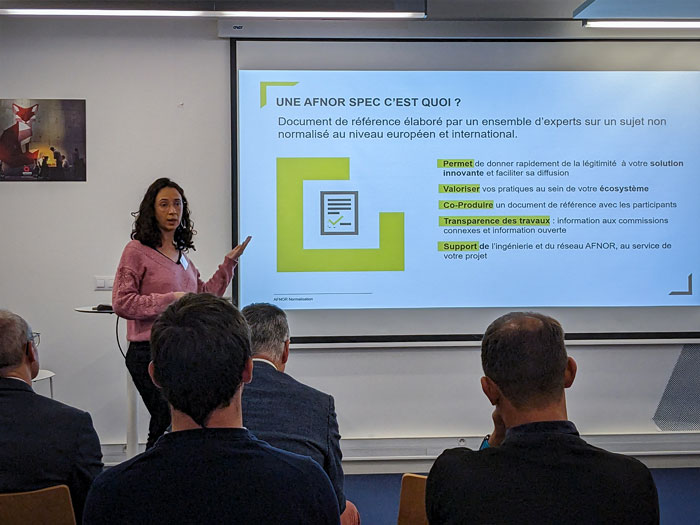
It is a reference document drawn up by a group of experts on a subject that is not yet standardized at the European or international level. It is only valid at the French level and is a way to promote practices and methods within an ecosystem.
The advantage of this document is that it becomes available after 8 to 18 months of work, and it serves as a basis for international standardization projects in the years following its publication. However, it is not a standard in the strict sense of the term, as it may contain advice, recommendations... And like any normative document, an AFNOR SPEC is applied on a voluntary basis.
Why did you opt for this type of document?
It is a good approach for issuing a normative document quickly: the timeframe is usually 2 years between launch and publication. Unlike other documents, this format can also be made available free of charge on the AFNOR website. It is therefore a good way to spread new practices.
And why the number 2212?
The number 2212 comes from a numbering rule: it is the 12th AFNOR SPEC of the year 2022.
What are the differences between an AFNOR SPEC and a standard?
A standard has to follow precise drafting rules. For example, everything it requires must be stated as a firm requirement (“shall”); it cannot simply put forward recommendations or proposals (“should”). An AFNOR SPEC, on the other hand, may contain this type of information.
Another point: a standard is established within standardization committees (French or international), whereas an AFNOR SPEC is drafted by a group of volunteer experts outside the standardization committees; although it is attached to them for the final publication of the document.
Finally, an AFNOR SPEC does not go through all the formal steps that standards are subject to. This makes it possible to publish the document within a much shorter timeframe than the one needed to draft a standard.
Can you describe the steps that were needed to create the AFNOR SPEC 2212?
Broadly speaking, AFNOR receives a request from one or more experts for the drafting of this type of document. A project manager then takes part in building the project roadmap with the volunteer experts. Once the terms have been set, an external consultation is launched so that anyone who wishes to, and who has the necessary skills, can join the working group.
After this one-month period, the kick-off meeting is held with all the stakeholders to define the detailed schedule of the work and meetings. It is also an opportunity for everyone to meet.
Then a series of working meetings takes place, with an improved version of the document circulated between each one, allowing everyone to prepare for the next meeting as well as possible and to submit any comments.
Once the content of the document has been finalized, the teams of AFNOR’s publishing department format it and publish it.
How long did this process take?
For the AFNOR SPEC 2212, the whole process took about 15 months.
What was the cost associated with creating this specification?
The cost depends on several factors, such as the number of meetings planned, the translation of the document by AFNOR... It is between €25k and €40k, shared between the various companies behind the request.
Are updates possible/planned?
If major errors are reported, an update may be considered. Until then, the committee and the experts are gathering any comments before deciding on a new version. Let’s give this version time to be challenged.
What are the next milestones for the AFNOR SPEC 2212?
The next step is the publication of the English version.
The document will remain valid in the French collection for a maximum of 5 years. In the meantime, the French committee can propose it as the basis for a new standardization subject at the international level, and thus contribute to the drafting of a new IEC(2) standard on printed circuit board routing parameters. Before that, the document must be accepted by the French ecosystem in order to further strengthen its legitimacy.
All the information about the standardization committee is available via: Structure AFNOR/UF 91 | Norm'Info

Noémie THOORES

Grégoire BOULAY
FRANCE CAO encourages you to download and read the latest version of AFNOR SPEC 2212 on the official AFNOR website, to ensure a complete and accurate understanding of the document. FRANCE CAO declines any liability regarding the accuracy or completeness of the information provided, and strongly recommends consulting the official source directly for any specific use or interpretation.
FRANCE CAO has obtained the reproduction, publication and exploitation rights for AFNOR SPEC 2212, allowing it to use this data in accordance with the terms of the intellectual property rights concession agreement established with AFNOR.
© AFNOR Editions - AFNOR SPEC 2212, 2023. Tous droits réservés.
PCB design rules: which values should you choose?
What is AFNOR SPEC 2212?
How to choose your routing class in AFNOR SPEC 2212
Advanced use of the AFNOR SPEC 2212 dynamic routing class ta…
Interview - Christian Maudet - AFNOR SPEC 2212
Interview - Noémie Thoores - AFNOR SPEC 2212
AFNOR SPEC 2212 goes international: IEC PAS 63720