AFNOR SPEC 2212 goes international: IEC PAS 63720

In two sentences:
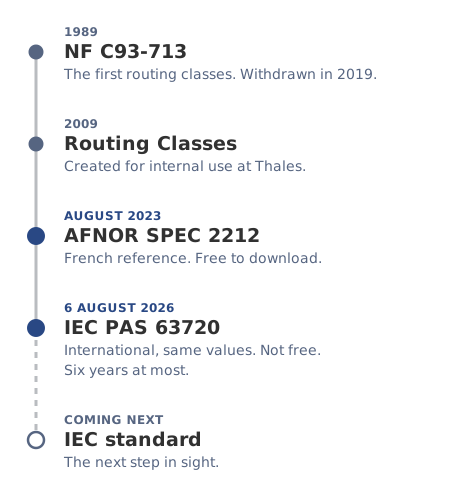
Since 6 August 2026, the routing classes of AFNOR SPEC 2212 also exist at international level, under the reference IEC PAS 63720. It is the same work, this time published by the International Electrotechnical Commission.
What changes in the document?
Nothing that forces you to revisit your projects. The document was taken up with no change to the parameters or the structure: the 10 routing classes, the 60-plus constraint parameters and the associated values are identical.
What changes is the reach. These routing classes are no longer a French reference only.
What is a PAS?
PAS stands for Publicly Available Specification.
Noémie Thoores explains in her interview what sets an AFNOR SPEC apart from a standard. I invite you to read it, or read it again.
A PAS follows the same logic, at international level. The IEC publishes it to respond quickly to a market need, based on the consensus of a group of experts, without waiting for the full International Standard process. Like the AFNOR SPEC, it then serves as the basis for building the standard.
Another thing they share: a limited lifetime. As Noémie pointed out, an AFNOR SPEC remains valid for five years at most. A PAS, for its part, is reviewed after three years and cannot exceed six. At that point, it either becomes an International Standard or it is withdrawn.
IEC PAS 63720 is therefore a step, not the end of the road. The next one is becoming an IEC standard.
Where to find it, and at what price?
The document is titled Rigid circuit board - Routing parameters. This is its first edition, published on 6 August 2026 by IEC technical committee TC 91, and it runs to 24 pages.
You can view it here, on the IEC webstore.
One significant difference from what you know: IEC PAS 63720 is not free. Expect CHF 160 for the electronic version as I write these lines, whereas AFNOR SPEC 2212 remains free to download.
So which one should you work from?
Today, both documents carry the same values. You can therefore keep using AFNOR SPEC 2212, free of charge, without any risk of getting it wrong.
Vigilance will come later. If IEC PAS 63720 evolves and an update is released, that update becomes the reference, and AFNOR SPEC 2212 will no longer be current. Remember to check this when starting your next projects.
Why this is good news
Work launched and carried out by French experts has been taken up internationally. The routing classes can become a common language well beyond our borders, between the designer, the printed circuit board manufacturer and the assembler.
That was the goal from the very beginning. Christian Maudet, who initiated the approach, was already talking about it in his interview.
FRANCE CAO encourages you to download and read the latest version of AFNOR SPEC 2212 on the official AFNOR website, to ensure a complete and accurate understanding of the document. FRANCE CAO declines any liability regarding the accuracy or completeness of the information provided, and strongly recommends consulting the official source directly for any specific use or interpretation.
FRANCE CAO has obtained the reproduction, publication and exploitation rights for AFNOR SPEC 2212, allowing it to use this data in accordance with the terms of the intellectual property rights concession agreement established with AFNOR.
© AFNOR Editions - AFNOR SPEC 2212, 2023. Tous droits réservés.
PCB design rules: which values should you choose?
What is AFNOR SPEC 2212?
How to choose your routing class in AFNOR SPEC 2212
Advanced use of the AFNOR SPEC 2212 dynamic routing class ta…
Interview - Christian Maudet - AFNOR SPEC 2212
Interview - Noémie Thoores - AFNOR SPEC 2212
AFNOR SPEC 2212 goes international: IEC PAS 63720